Âé¶¹´«Ã½ÊÓÆµ

Design spaces. Shape cities. Build a career with purpose.

Architecture is about more than buildings - it's about how people live, move, and connect. On this course, you'll learn how to design spaces that are functional, sustainable, and meaningful, while developing the creative and technical skills needed for a professional career in architecture.

From day one, you'll work on real design challenges, build a professional portfolio, and gain the confidence to turn ideas into buildable solutions.

Why this course? Because it combines creative design, real-world experience, and clear career progression - helping you move from student to architect with confidence.

Illustration of a head being split in half with colours escaping.

Don't meet the full entry requirements?

Arts Foundation Year

The Arts Foundation Year at Lincoln is the first year of a four-year degree programme, offering students the chance to explore a range of creative subjects including Animation, Architecture, Fine Art, Graphic Design, Illustration, Photography, and Product Design before progressing onto a specialist degree.

Why study Architecture at Lincoln?

  • Design-led, career-focused learning
    Build a portfolio that employers and practices actually want to see.

  • Accredited pathway to becoming an architect
    This degree is RIBA validated and designed to support your journey toward professional qualification.

  • Studio-based teaching from day one
    Learn by doing, not just listening.

  • Dedicated design studios
    Your own creative space to develop ideas and collaborate.

  • Strong focus on sustainability and real-world design
    Tackle the challenges shaping modern cities and environments.

  • Industry-informed projects
    Work on briefs that reflect real architectural practice.

  • Supportive, collaborative studio culture
    Learn alongside peers, guided by practising architects and academics.

  • A city that inspires design thinking
    Lincoln blends historic architecture with modern development — a living case study.

What you'll learn

This course is structured to help you think and work like an architect — combining creativity, technical knowledge, and problem-solving.

You’ll learn how to:

  • Design buildings and spaces that respond to real human needs
  • Develop creative concepts into detailed, buildable designs
  • Use industry-standard tools such as CAD and digital modelling software
  • Understand construction and materials, so your ideas can become reality
  • Explore sustainability, including environmental design and responsible building
  • Communicate your ideas visually and verbally, a key skill in architecture careers

By the end of the course, you’ll graduate with a professional portfolio showcasing your design work.

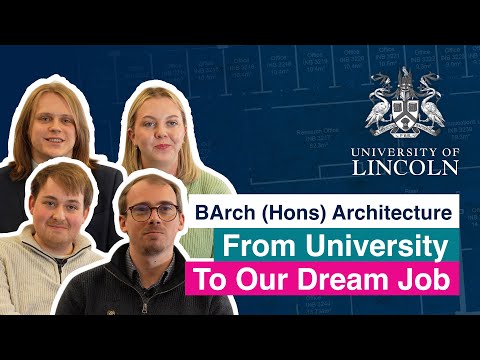
Meet Our Graduates!

From the University of Lincoln to jobs in their field, here's how our Architecture graduates valued their time at Lincoln. Find out what our graduates enjoyed, what they miss about University and how their course prepared them for their careers.

YouTube video for

Modules

Module Overview

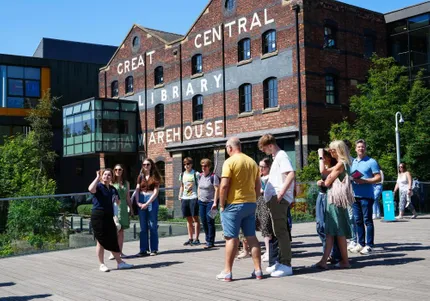
How is a building put together, and why does it feel comfortable to live in? You will learn how traditional and sustainable buildings are constructed, and how choices about materials and joints affect light, warmth, sound, and health. You will draw a construction detail with a partner, then build your own scale model of it, layer by layer. Where possible, you will visit real buildings to see the construction first-hand.

Module Overview

Learn to think like a designer. In the studio you will take small projects from first idea to finished proposal, testing and refining as you go. You will learn to sketch, draw plans, sections, and elevations, and make physical models, using each one to explore ideas and explain them. You will also begin to read a site, its climate, and its character, and to design with them in mind.

Module Overview

What does it mean to dwell? You will design a home, such as a house, a pod, or a shelter, and decide how bold your idea should be. You will think about the people who will live there, including their privacy, their daylight, and how they make a place their own. You can approach the design through the building, the interior, or both, with drawings and models that become more detailed as your idea develops.

Module Overview

Start with the digital and professional skills that every architecture and interior design student needs. In computer labs you will learn industry software, from drawing and 3D modelling to the shared digital models that design teams use to plan whole buildings. With your group, you will plan and put on a real event, such as an exhibition or a talk. You will also begin a reflective log and your first CV.

Module Overview

Why do buildings look and work the way they do? You will travel from the first human settlements to the early modern world, looking at homes, cities, landscapes, and interiors from many cultures, not only the European canon. In workshops you will draw, diagram, and model what you learn, so that history becomes a tool you can use in your own design work.

Module Overview

How did industry, empire, modernism, and technology shape the places we live in today? This module follows buildings and interiors from the Industrial Revolution to the present, and asks what they mean for our behaviour, our health, and the climate emergency. You will study a few precedents in depth, choose one of your own, and combine hand drawing with writing to explain what you find.
Module Overview

The Industry Placement Year is an exciting opportunity for students to take a year out of formal study to gain real-world experience in the creative industries. Whether you’re looking to build industry connections, develop professional skills, or explore career options, this year will give you a full-time, hands-on experience within a creative organisation.

This year is a collaborative experience between you, your employer, and the University—ensuring that you get the most out of your time in a professional setting.

Module Overview

This module provides an opportunity for students in the Lincoln School of Design & Architecture to spend a semester in Year 2 studying at one of the University’s partner institutions. This opportunity has both academic and personal development dimensions.

In academic terms, during the semester abroad students undertake models that are equivalent to 60 credit module and content at one of the UoL partner institution in semester B.

Participation in study-abroad also offers unique opportunities for personal student development in the wider sense. Although students will be supported through the application process by the Module Co-ordinator and colleagues at the partner institution, much of the responsibility for organising the time abroad rests with the student. Study abroad offers the opportunity for students to develop graduate attributes, a global mindset and transferrable skills as exercise resilience, flexibility and open mindedness when adapting to and working effectively within a different academic culture and environment.

Students must submit an application to the School discuss why they wish to participate in a study period abroad.

Module Overview

This module is optional for undergraduate students within the College of Social Sciences and Humanities. Study Abroad enables you to study at one of the University’s approved partner institutions.

During the time spent abroad, you can share classes with local students and study modules at the partner institution which have been approved in advance by the University. As many partner institutions support internships, you may choose to combine study with work and/or a period of volunteering.


† Some courses may offer optional modules. The availability of optional modules may vary from year to year and will be subject to minimum student numbers being achieved. This means that the availability of specific optional modules cannot be guaranteed. Optional module selection may also be affected by staff availability.

Support and student experience

Starting university, and a demanding creative course, can feel like a big step. You won’t do it alone.

Academic support

  • Regular feedback on your design work
  • One-to-one guidance from tutors
  • Structured studio sessions to build confidence

Personal support

  • Wellbeing and mental health services
  • Academic skills support (writing, research, time management)
  • Career guidance from early in your degree

Studio culture

Architecture is collaborative, and so is your experience here.

  • Work alongside your peers in shared studio spaces
  • Learn how to give and receive constructive feedback
  • Build friendships and professional networks that last beyond graduation

Accreditation

This course is validated by the Royal Institute of British Architects (RIBA) as providing exemption from Part 1 examinations, which are required to register as an architect in the UK.

The RIBA logo

International Study and Placements

International Study

Study overseas at a partner university and experience a new culture.

  • Build confidence, independence, and intercultural experience
  • You’ll pay the relevant study abroad fee to the University of Lincoln, with no tuition fees paid to the host university
  • You’ll need to cover travel and living costs
  • Funding support may be available


Placements

Gain hands-on experience in a real workplace and apply your learned skills in a professional setting.

  • Develop practical skills and professional confidence
  • Build your CV before you graduate
  • Explore career options in a real workplace
  • Pay a placement year fee
  • You’ll need to cover travel and living costs

My time at Lincoln has enhanced the meaning of architecture, allowing me to understand how it impacts people and place. The teaching has helped me to analyse opportunities and constraints in a much more rigorous way. The collaboration with my tutors gave me the support to allow me to succeed.

Careers and future opportunities

A degree in Architecture opens the door to a wide range of creative and technical careers.

What can you do with this degree?

Graduates commonly move into roles such as:

  • Architectural Assistant
  • Junior Architectural Designer
  • Urban Designer
  • Interior Architect
  • 3D Visualiser / Architectural Visualisation Specialist

Where could you work?

  • Architectural practices
  • Design consultancies
  • Property and construction companies
  • Local authorities and planning organisations
  • Creative industries and design studios

Pathway to becoming an architect

This course forms the first step toward qualifying as a registered architect in the UK. Many students go on to:

  1. Complete a year in industry (placement)
  2. Study a master’s degree
  3. Finish professional training

Reassurance for students

  • You graduate with real, employable skills and a portfolio
  • You’ll understand how the industry works, not just theory
  • You’ll be prepared for further study or immediate entry-level roles

Entry Requirements 2027-28

United Kingdom

104 to 112 UCAS Tariff points from a minimum of 2 A Levels or equivalent Level 3 qualifications.

If you are eligible for a contextual offer, a one grade or 8 UCAS Tariff point reduction to the standard entry requirements will be applied.

A Level: BBC

BTEC Extended Diploma: DMM

T Level: Merit

Access to Higher Education Diploma: 45 Level 3 credits with a minimum of 112 UCAS Tariff points.

International Baccalaureate: 29 points overall

GCSE's: Minimum of three at grade 4 or above, which must include English and Maths . Equivalent Level 2 qualifications may be considered.


The University accepts a wide range of qualifications as the basis for entry and do accept a combination of qualifications which may include A Levels, BTECs, Extended Project Qualification (EPQ).

We will also consider applicants with extensive and relevant work experience and will give special individual consideration to those who do not meet the standard entry qualifications.


Additional requirements:

- Applicants will be asked to produce a digital portfolio of work.

International

Non UK Qualifications:

If you have studied outside of the UK, and are unsure whether your qualification meets the above requirements, please visit our country pages/studywithus/internationalstudents/entryrequirementsandyourcountry/ for information on equivalent qualifications.

EU and Overseas students will be required to demonstrate English language proficiency equivalent to IELTS 6.0 overall, with a minimum of 5.5 in each element. For information regarding other English language qualifications we accept, please visit the English Requirements page/studywithus/internationalstudents/englishlanguagerequirementsandsupport/englishlanguagerequirements/

If you do not meet the above IELTS requirements, you may be able to take part in one of our Pre-sessional English and Academic Study Skills courses.

For applicants who do not meet our standard entry requirements, our Arts Foundation Year can provide an alternative route of entry onto our full degree programmes:
/course/afyafyub/

If you would like further information about entry requirements, or would like to discuss whether the qualifications you are currently studying are acceptable, please contact the Admissions team on 01522 886097, or email admissions@lincoln.ac.uk

Contextual Offers

At Lincoln, we recognise that not everybody has had the same advice and support to help them get to higher education. Contextual offers are one of the ways we remove the barriers to higher education, ensuring that we have fair access for all students regardless of background and personal experiences. For more information, including eligibility criteria, visit our Offer Guide pages. If you are applying to a course that has any subject specific requirements, these will still need to be achieved as part of the standard entry criteria.

Is this course right for you?

This course could be a great fit if you:

  • Enjoy art, design, or creative problem-solving
  • Are curious about buildings, cities, and how people use space
  • Want a career that combines creativity with real-world impact
  • Like the idea of working on projects rather than just exams

You don’t need to have everything figured out, but you should be ready to explore, experiment, and develop your ideas.

Fees and Funding

University Study is a major investment, so it’s important to understand the costs and support available. A full breakdown of the fees associated with this programme can be found below. Eligible students may be able to access scholarships and bursaries to help with study costs.

Course Fees

Course-Specific Additional Costs

Standard workshop induction costs are usually covered by the University, as are some initial printing and material costs. However, depending on the media/materials chosen by the student, there may be additional material and printing costs incurred.

Mandatory field trip costs are covered by the University, but optional study visits which may include international trips or a student exchange programme, are at the student’s own expense.

What You Need to Know

We want you to have all the information you need to make an informed decision on where and what you want to study. In addition to the information provided on this course page, our What You Need to Know page offers explanations on key topics including programme validation/revalidation, additional costs, and contact hours.

The University intends to provide its courses as outlined in these pages, although the University may make changes in accordance with the Student Admissions Terms and Conditions.